
Are you fighting tigers or kicking goals?

We all sometimes find ourselves operating from a sense of threat - where we aren't comfortable in a situation and we choose to see the people around us as obstacles or competitors.
Take a moment to think about your situation and your working relationships.
Are you more likely to celebrate with, or withhold information from, the people around you?

As a team leader or business owner, it pays to be conscious about the mental frame you place on your situation and relationships.
Research has shown that when our threat response (also referred to as the "away" response) is triggered, our physiology prepares us for a physical reaction: to fight or to flee.
Fear works, but at a cost.
That cost increases over time - draining energy, productivity and creativity, and stunting relationships.
This happens because the threat response uses up oxygen and glucose from the blood, diverting it from areas such as working memory which processes new information and ideas.
In a work context, fear and pain lead to us "shutting down" - limiting our commitment and engagement.

On the other hand, our curiosity and reward-seeking response - what you might call the "toward" response - is less intense, but it allows us to use that higher order thinking that allows creativity, problem-solving, and social connection.
And importantly, when the toward response is activated, we feel a sense of well-being.
We also need to know that the choice of away or toward response is triggered by how our brains interpret an event.
And that interpretation is not set in stone.
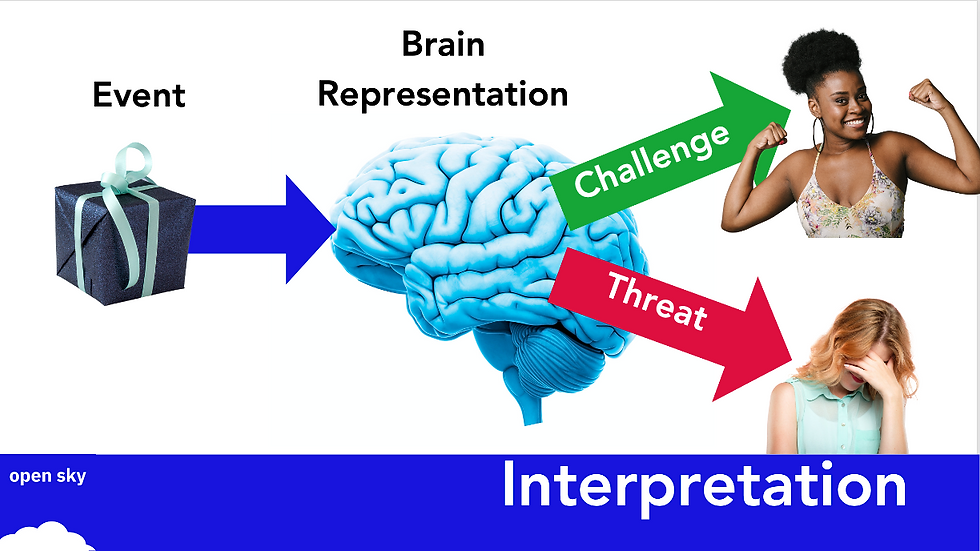
When we consciously choose to see problems as shared challenges, our physiology adapts to support higher order functions such as problem solving, creativity, and empathy (referred to as the "toward" response) - helping us find better solutions to those problems and to strengthen relationships.
Individually, we can choose to reframe uncertain situations by telling ourselves "I am excited" rather than saying "I am anxious", and looking for opportunity in those situations rather than focusing on the difficulty (see here for more information on the research behind this recommendation).
As leaders and collaborators, we also have a powerful ability to influence the way others see us and our shared situations.
Often in large organisations, leaders aggressively compete for and withhold resources from other teams, sending the implicit message to their teams that they need to be "fighting tigers" internally. This frames these internal relationships as conflict, dramatically reducing the potential of the human resources inside the organisation!

When we model and describe shared opportunity and possibility instead of competing for resources, the people we influence are more likely to focus on shared goals and collaboration, rather than seeing us as a threat.

This is so important!
We have the power to choose how we will react, and to influence how others will react, to our situation. And when we choose to focus on the opportunity rather than the threat, everyone involved is likely to be better equipped to solve the problem or achieve the goal.

Comments